Moving to Oʻahu: A Real Estate Relocation Guide
If you’re moving here from the mainland, the hardest part usually isn’t “finding a house.” It’s figuring out which part of Oʻahu matches your real weekday life—commute time, parking, weather comfort, and the little rules that can make a home feel easy or feel like work.
You’ll see a few local terms here. “Mauka” means toward the mountains, “makai” means toward the ocean, and “pau hana” is the after-work window when traffic and errands get real.
- Choose an area based on day-to-day fit (not just a map).
- Understand condo vs single-family trade-offs.
- Know what to verify by address (flood/noise/rules).
- Build a timeline that keeps you in control.
- It’s for mainland homebuyers making decisions from afar.
- It’s not a neighborhood ranking list.
- It’s not trying to sell you one specific town.
- It’s meant to give you clarity before you fly out.
If you already have a short list, we can sanity-check it. If not, start with the section below to get your bearings.
Before You Pick a Neighborhood, Picture Your Weekday Life
On Oʻahu, the “right” location usually shows up in the small stuff: where you’ll grab groceries on a Tuesday, how long it takes to do school drop-off, and whether you can pop over to Ala Moana without turning it into a mission. When mainland buyers feel confident here, it’s because the home fits the life you actually live—not just the view you liked on your phone.
A simple way to navigate: Mauka is toward the mountains, Makai is toward the ocean. Two places can be “ten minutes apart” on a map but feel totally different once you add wind, rain, and the roads you’ll drive every day.
- Mauka = Uphill / Mountains
- Makai = Water / Ocean
.png)
Pick 3 places you’ll visit often—groceries (Foodland, Safeway), a gym, and a favorite “easy dinner” spot. If those are convenient, the whole move feels smoother.
If your routine pulls you between Leeward (Kapolei/ʻEwa) and Town (Ala Moana/Waikīkī), your day will feel different than someone who stays in one pocket.
In condos especially, parking is lifestyle. One stall vs two, guest parking rules, and how easy it is to unload groceries matter more than you expect.
Trade winds and humidity change how a home feels—especially if you work remote. This is where mauka/makai and Windward vs Leeward starts to click.
- Run your likely commute at two times: a morning start and pau hana (after work).
- Pick one “daily errand” destination (Costco, Target, or Grocery) and check the drive.
- If considering Town/Condos: Ask early about elevator access and guest parking.
- When you visit: Do one normal errand run around 4:30–6:00 PM to feel the real rhythm.
The good news is: once your weekday routine makes sense, buying here starts to feel a lot more fun—because you’re not guessing. Next, we’ll talk about a big fork in the road: how Windward and Leeward living differ.
Windward vs Leeward Feels Different Day to Day
This is one of those Oʻahu things that’s hard to understand from listings alone. Windward (the Koʻolau side—think Kailua and Kāneʻohe) and Leeward (the sunnier side—think Kapolei and ʻEwa) can both be great places to live, but the day-to-day experience often changes with the trade winds, passing showers, and how your home is positioned on the mountain side (mauka) or ocean side (makai).
The goal here isn’t to “pick a winner.” It’s to help you choose a comfort level you’ll be happy with on a normal workweek—when you’re doing laundry, working from home, running errands, and coming back pau hana (after work).
A lot of homebuyers love Windward because it can feel greener and cooler, with trade winds that make open windows and a shaded lanai feel genuinely comfortable. You’ll also notice more passing showers—often the quick “in and out” kind that changes the mood of the day without ruining it.
Leeward living often feels brighter and drier day to day. For many mainland relocations, that “predictable sunshine” is a big quality-of-life win—especially if you want more outdoor time after work. Depending on the home and airflow, some households prioritize A/C or strong cross-breezes to keep afternoons comfortable.
Town areas like Kakaʻako, Ala Moana, and parts of Waikīkī sit in their own “micro-weather” depending on building height, shade, and how close you are to the water. For condos, the unit’s exposure and airflow can matter as much as the neighborhood name.
- Do you sleep best with windows open and airflow, or do you prefer consistent A/C at night?
- Will you be home midday (remote work, kids, flexible schedule), or mostly out until pau hana?
- Is “bright and sunny most days” the goal, or do you like a cooler, greener feel even if you get more passing showers?
- For condos: what direction does the unit face, and does the lanai get morning sun, afternoon sun, or mostly shade?
If you can, spend one afternoon on each side: grab coffee in Kailua or Kāneʻohe, then do an errand run in Kapolei or ʻEwa. Even without touring homes, you’ll feel the difference in sun, breeze, and how the drive-time reality plays out.
Once you know which day-to-day comfort you’re aiming for, the next piece gets easier: understanding the commute corridors mainland homebuyers ask about first—H-1, H-2, H-3, and the routes that connect Windward to Town.
How People Actually Get Around Oʻahu (H-1, H-2, H-3)
Mainland homebuyers usually start with a map. People who live here start with the roads they’ll use every week. On Oʻahu, a home can look perfect online, but it’s the drive-time reality—school drop-off, Costco runs, getting to the beach after work—that decides whether daily life feels easy.
The simple framework: H-1 is the main east–west freeway most people lean on. H-2 connects Central Oʻahu toward Mililani and Wahiawā. H-3 is the big Koʻolau crossing that links Windward to the Pearl Harbor / ʻAiea / Halawa side, where you typically continue on toward Town via H-1 or surface roads. Around those, you’ll hear everyday names a lot—Nimitz, Kamehameha (“Kam Hwy”), Farrington, Pali, Likelike, Kalanianaʻole.
If you’re living Leeward (Kapolei/ʻEwa) or Central (Pearl City/ʻAiea) and commuting toward Town (Downtown/Ala Moana/Kakaʻako edges), H-1 is usually the main path. You’ll also hear Nimitz Hwy mentioned as a parallel option closer to the airport and harbor side.
H-2 is the connector buyers often don’t think about until they’re here. If Mililani or Wahiawā is on your short list, H-2 tends to be part of daily life. You’ll also hear Kam Hwy in the same breath because it stitches together a lot of everyday stops.
For Kailua and Kāneʻohe buyers, H-3 is often the “big connector” toward the Central / ʻAiea / Halawa side. You’ll also hear Pali Hwy and Likelike Hwy come up as alternate mountain crossings depending on where you start and where you need to land.
On the North Shore and West Side, it’s less about freeways and more about Farrington Hwy and Kamehameha Hwy. The pace feels different on two-lane stretches, and “distance” doesn’t always match how long a trip feels in real life.
- Pick two anchor points you’ll repeat weekly: a work address (or base) and your main errands stop (Costco, Target, grocery).
- Check the route at two times: a morning start and the after-work window. You’re not hunting a perfect number—you’re looking for consistency and how the trip feels.
- For Town condos, add a quick “building reality” check: garage access, elevator time, guest parking, and how it feels unloading groceries.
- If you’re Windward, compare H-3 vs Pali vs Likelike for your specific start/end points. One usually fits better than the others.
Instead of North/South, you’ll hear “Town-bound” (heading toward Honolulu) and “ʻEwa-bound” (heading west, away from the city). Once you know those two directions, listening to the morning traffic report actually becomes useful.
Once you’ve got your main routes in mind, the next decision gets a lot clearer: condo vs single-family on Oʻahu, and which trade-offs actually matter for your day-to-day life.
Condo vs Single-Family on Oʻahu: What Changes in Daily Life
This is one of the first major choices for mainland homebuyers. On paper, it can look like a simple decision—condo for convenience, single-family for space. In real life on Oʻahu, the difference shows up in everyday details: parking, storage, noise, maintenance, how you get groceries into the home, and how much of your weekend you want to spend on upkeep.
The good news is there’s no “wrong” answer—there’s just a better match for the way you live. If you know what actually changes day to day, you can choose with confidence instead of guessing from photos.
In Town areas (Ala Moana, Kakaʻako, Waikīkī edges), a condo can make daily life feel simple: close to groceries, quick access to restaurants, and less exterior maintenance on your personal to-do list.
- Parking is lifestyle: one stall vs two, guest rules, where visitors actually park.
- Elevators + loading: how easy it is to bring in groceries, strollers, surfboards, or Costco hauls.
- Building rules: pets, rentals, move-in rules, and quiet hours (it varies a lot by building).
- Monthly fees often cover shared upkeep—building maintenance, amenities, and common areas.
A single-family home is often the space-and-privacy choice: more breathing room, a yard for pets or kids, and the freedom to garden, host, or set up storage without building rules. In Windward and many Leeward neighborhoods, this is the lifestyle draw.
- More privacy and fewer shared walls (which some people just sleep better with).
- Outdoor space for a grill, plants, storage, rinsing beach gear, or a simple weekend hang.
- Upkeep is yours: landscaping, roof, exterior paint, and salt-air wear over time.
- Parking style can be easier—but it varies by neighborhood and driveway/garage setup.
@0.75x.png)
If you’re condo shopping, you’ll hear AOAO—it’s basically the condo association (the group that manages the building rules, budgets, and shared upkeep). Every building feels a little different, which is why the “parking, pets, and rental rules” questions below matter so much.
- How many assigned stalls, and where is guest parking really?
- Are pets allowed, and are there size or number limits?
- What’s the rule on rentals (short-term vs long-term)?
- How does moving in work (elevator reservations, loading area, hours)?
- What kind of outdoor upkeep fits your schedule (yard size, landscaping)?
- Is there good cross-breeze, or will you rely on A/C more often?
- How’s the parking setup for your household and visitors?
- Any practical “home systems” notes to understand early (roof age, solar setup, etc.)?
Next up: the “verify by address” items that can make a home feel smooth on day one—things like flood and drainage context, noise patterns, parking realities, and the small rules that aren’t obvious until you live here.
Verify by Address: The Stuff You Can’t Tell From Photos
A lot of mainland homebuyers do the “right things” online—read the description, check the map, zoom in on the street view. On Oʻahu, the confidence usually comes from one extra step: verifying the address so you understand how the home will feel on an ordinary week.
This isn’t about being overly cautious. It’s about making the move smoother—so when you arrive, you already know the practical details that shape daily life.
Some pockets handle heavy rain beautifully; others hold water longer. A quick flood-zone and drainage check tells you what a stormy week looks like at that address.
This is a common “new-to-Oʻahu” surprise. Near freeways, busy streets, or certain flight patterns, sound can become part of the daily feel—easy to check up front, and it makes tours more enjoyable.
For condos, it’s assigned stalls and guest parking rules. For single-family, it’s driveway width and the real street-parking situation when friends visit.
Two units in the same building can feel different based on airflow and sun exposure. A lanai facing late-day sun changes how you’ll use that space.
Condo pet policies, rental limits, and move-in rules can shape daily life. Getting clean “yes/no” answers early keeps the search light and focused.
When you verify these items early, tours get more fun—you’re comparing fit, not worrying about surprises after you land.
Next up: timing your move and your purchase. A good timeline keeps the process calm—especially if you’re coordinating flights, temporary housing, and a lender from the mainland.
Homes on Oʻahu Have Their Own Maintenance Priorities
One of the best parts of buying on Oʻahu is how quickly the place starts to feel “right” once the everyday stuff matches your life—breeze, shade, parking, and a home that’s comfortable on a normal workweek. The maintenance side is part of that comfort. It’s not harder here, just a little different than what most mainland homebuyers expect.
If you understand the big themes—moisture, salt air, sun exposure, and termites—you’ll read inspection notes with a lot more confidence. Most homes will have “items.” The goal is knowing which ones are routine for Hawaiʻi and which ones deserve a second question.
Windward and mauka homes can feel cooler and greener, but good airflow is what keeps a home feeling fresh day to day. In condos, the unit’s exposure matters—cross-breeze vs still air changes comfort.
- Look for: windows you’ll actually open, fans that make sense, and shaded sides that don’t stay damp.
- Ask: how the home feels after a rainy stretch, not just on a sunny showing day.
Near the ocean, salt air works on metal faster—railings, hardware, window tracks, outdoor fixtures, and A/C components. Homes that feel “easy” tend to have smart materials and a simple rinse-and-check habit.
- Look for: clean hardware, railings that aren’t flaking, and exterior fixtures that have been cared for.
- Check: A/C condenser area, lanais, and any exposed metal near the coast.
Mainland buyers sometimes tense up when they see termite notes in disclosures. Here, termite prevention is simply part of responsible ownership—like yard care or servicing A/C.
- Look for: a current treatment plan or warranty and clear documentation.
- Ask: when the last treatment was and what’s been done routinely since.
Trade winds are part of what makes the island feel good, and they also show up in how roofs, eaves, and exterior finishes age. Inspectors pay close attention to roof condition, flashing, gutters, and how the home sheds water during heavy rain.
“Good bones” usually means the home drains well, has practical airflow, shows honest wear (not hidden moisture issues), and has a clean story on big-ticket systems like roof, electrical, plumbing, and past repairs. It’s the kind of home that feels steady, not fussy.
If you tour an older home and the walls feel thinner than you’re used to, it may be single-wall construction. That’s a well-known local style where the wall assembly is simpler than modern drywall-and-insulation builds.
For mainland homebuyers, it can look “basic” at first glance. In day-to-day living, many people appreciate the airflow and the way these homes can feel comfortable with fans and trade winds. It’s not automatically better or worse—it’s just different, and it’s worth understanding before you compare it to newer construction.
Next up: renovations and permit history. On Oʻahu, “what was done” matters—but “what was approved” matters even more, especially when you’re buying from the mainland and want clean financing and clean resale later.
Renovations and Permit History Matter More Than Most Mainland Buyers Expect
If you’re relocating from the mainland, this is one of the easiest “confidence upgrades” you can give yourself early: get clear on what was permitted and what was simply “done.” On Oʻahu, homes get improved in practical, everyday ways—enclosing a lanai for more interior living, adding solar, updating kitchens, building an ʻohana unit (a second living space for family), or reworking a carport into something more useful.
None of this is meant to scare you off. It’s about clarity. When you understand the paper trail, your lender, your insurer, and your inspector are all reading the same story—and your decision feels calm instead of rushed.
It’s the record of what the City reviewed and signed off on—additions, structural changes, major electrical/plumbing work, solar installs, and other upgrades that change how the home functions.
Lenders and insurers care about consistency: does the home’s current layout match what’s documented, and were major changes done to code. When it lines up, the transaction usually feels smoother.
Enclosed lanais, converted garages/carports, added bathrooms, PV solar, and extra living spaces can be great lifestyle wins—just worth confirming early so you know what you’re buying.
You’ll see TMK (Tax Map Key) on every listing. It’s the parcel ID used for property records and permits. If an address is tricky (or a property has multiple address points), the TMK is usually the cleanest way to confirm you’re looking at the right record.
Pro tip: If a listing mentions “added bedroom,” “enclosed lanai,” “ʻohana unit,” or “new solar,” treat that as a cue to check permits early.
Next up: wastewater systems. If you’re looking outside of the most urban pockets, you may run into septic or cesspool setups—and knowing what you have (and what it means) keeps the process straightforward.
Septic, Cesspools, and Wastewater: Know What You’re Buying
On Oʻahu, some homes are connected to a public sewer, some use a septic system, and some have a cesspool. None of that automatically makes a home “good” or “bad”—it just changes what you maintain and what you plan for as an owner.
If you’re shopping from the mainland, the win is clarity. Once you know which system the property uses, your inspection questions get simpler, your lender conversations get cleaner, and your next steps feel straightforward instead of fuzzy.
.jpg)
This is the “set it and forget it” option most mainland homebuyers expect. You’re connected to the municipal system, so ownership is mainly normal interior plumbing upkeep.
A private tank and leach field on your lot. Well-maintained septic is a normal ownership setup—it just comes with a simple service rhythm.
An older style that still shows up in certain pockets. The key is not panic—it’s simply knowing what you have, what the current condition is, and what an upgrade path could look like over time.
- Where are the tank and leach field located on the lot?
- When was it last serviced or pumped, and are there records?
- Can the inspector perform the right checks for this specific system?
- Any history of backups, odors, or high-water issues after heavy rain?
- Where is it located relative to property lines and improvements?
- What are the realistic upgrade options for this property over time?
Good to know: In Hawaiʻi, cesspools are a known statewide planning topic. If a home has one, the goal is simple—understand the condition and the long-term path early, so the purchase stays calm and predictable.
Next up: schools, activities, and after-school logistics—because on Oʻahu, drive-time reality isn’t just work. It’s pickup lines, practice fields, and the beaches where your weekends naturally land.
Schools, Activities, and After-School Logistics
When mainland homebuyers ask about schools on Oʻahu, they’re usually asking something bigger than a rating. They’re asking: what does a normal weekday feel like?
The easiest way to find “fit” fast is to look at drive-time reality. Drop-off to work, then practice, then dinner—does it flow without turning into a daily hassle?
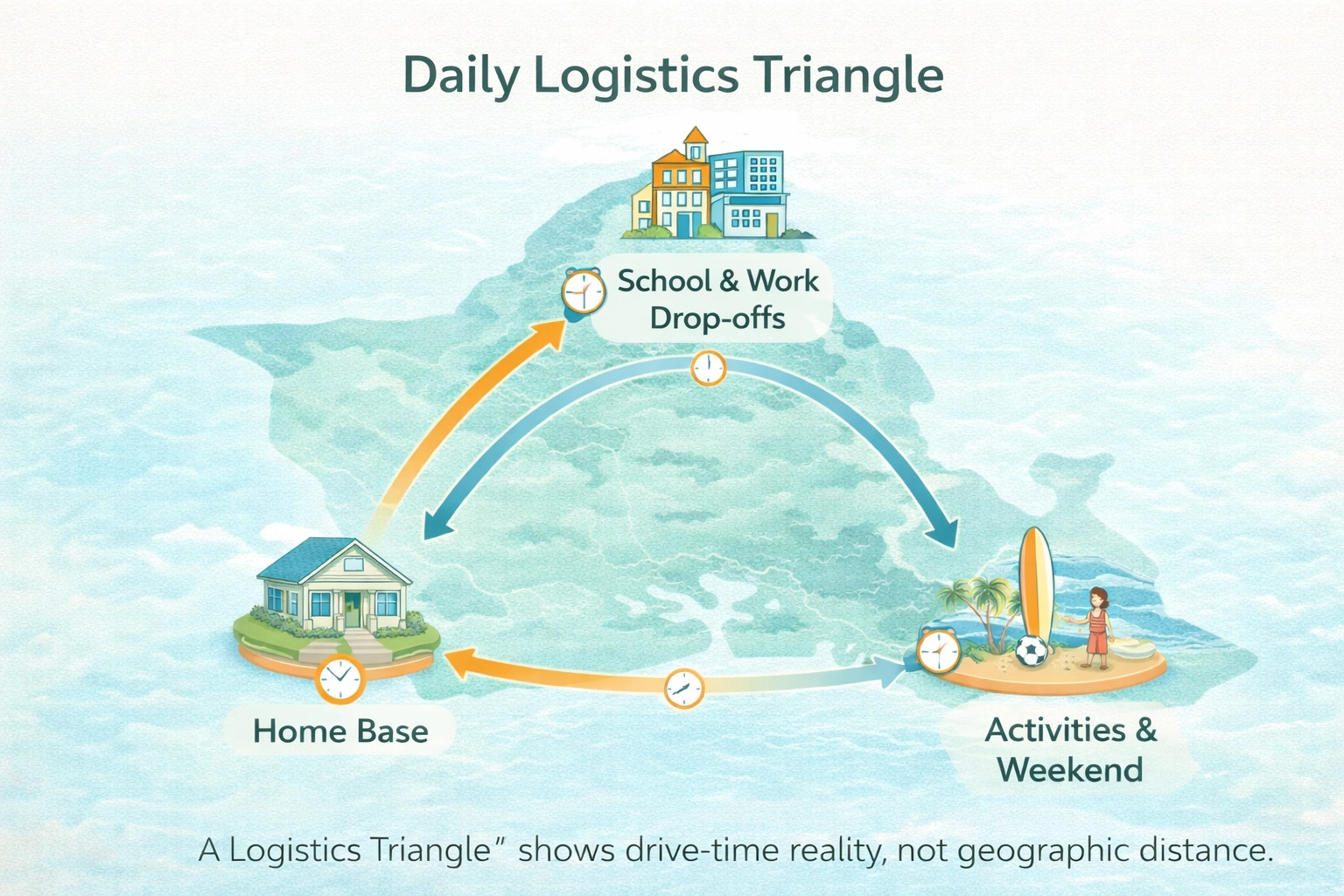
Think in three points: home → school → activities. If that triangle feels easy on a weekday, the neighborhood usually feels right long-term.
Boundaries can be strict and occasionally shift. Confirming the specific address early keeps you from building your search on the wrong assumption.
Look for practical match: after-school care, immersion options, arts, athletics, or campus culture. Those details shape stress levels more than a score.
A school that looks “close” can feel far if the approach roads stack up. If you can, test the drive around pickup time—not just on a weekend.
Weekends are the real test. If your household lives at Ala Moana, heads to Kailua Beach Park, or hikes Koko Head, being closer to your “go-to” spots keeps life lighter.
You’ll hear “keiki” (kids) and “ʻohana” (family) a lot—in school emails, sports schedules, and neighbor chats. Knowing the language helps you feel at home faster.
- The route: Work → school → practice → home. Does it stay predictable?
- The dinner stop: Is Foodland, Safeway, or Times on the way—or a detour?
- The weekend: Does getting to your beach or trail spot feel easy enough to do often?
Next up: a simple relocation timeline that keeps you in control—so your short list, showings, and due diligence line up without turning the move into chaos.
A Simple Relocation Timeline That Keeps You in Control
Buying from the mainland can feel hectic when everything stacks up at once—flights, tours, lender calls, inspection windows. The calm approach is a simple sequence, so you’re never guessing what matters this week.
Treat this like a flexible checklist. You’ll still move fast when the right home shows up—just without skipping the steps that prevent regret.
Build a short list that matches your weekday life—not just a vibe in photos.
- Choose areas based on school drop-off / work start times.
- Talk to a lender early so your budget is real, not a guess.
- Set non-negotiables (parking, pets, A/C, stairs vs one-level).
- Start “address checks” (flood, noise, boundaries, rules).
Fewer tours, better tours. This is where clarity saves you time.
- Schedule focused showings around real traffic, not Sunday calm.
- If condo: review rules, parking, and fees early—before you tour ten more.
- Line up inspectors (and specialists if needed) before calendars fill.
- Plan logistics (flights, short-term stay, moving timeline).
Move quickly, but keep the “verify fast” checks in place so the decision stays solid.
- Confirm the address story: drainage, noise, parking, boundaries.
- If condo: re-check pet/rental rules and parking reality.
- Permit clarity: verify obvious upgrades before you get too far.
- The “weekday fit” check: does it actually work for your daily triangle?
If you’re renting short-term first, decide in advance what “good enough” looks like. Keep the temporary plan simple so your attention stays on the actual home.
Next up: how we help mainland homebuyers buy with confidence on Oʻahu—the local verification steps we run, the questions we ask early, and how we keep your short list tight without boxing you in.
How We Help Mainland Homebuyers Buy With Confidence on Oʻahu
Buying from the mainland usually feels manageable right up until the details start stacking—condo rules, drive-time reality, permit records, drainage, and the quiet “is this normal here?” questions that don’t show up in listing photos.
Our job is to make the process feel steady. We run the checks that reduce surprises, translate local terminology in plain language, and tighten your short list so your showings stay focused.
Flood and drainage context, noise patterns, parking reality, and breeze exposure—so you understand how the home will feel on an ordinary week.
We get answers on the items that change daily life—parking assignments, guest rules, pet limits, storage, and the “quiet-hours” reality.
When a listing mentions an enclosed lanai, added bath, or an ʻohana unit, we confirm the paper trail early so financing and insurance stay straightforward.
We narrow options based on your weekday needs—work routes, parking, comfort (breeze vs. A/C), and what you want weekends to feel like.
If you’re torn between two areas (or two property types), a quick call usually saves weeks of second-guessing. We’ll compare your real weekday routes and the rules you’d be living with—so the choice gets clearer fast.
- Work location or base area (approximate is fine).
- School needs and after-school schedule.
- Your usual errands stops (Costco, Target, grocery).
- Anything that’s a hard “no” (stairs, no parking, noise).
- Condo vs single-family leaning (and why).
- Parking needs (cars, guests, storage).
- Comfort needs (breeze vs A/C, sun, noise).
- Any “musts” like lanai, elevator, or ground-floor access.
Small but important: If you already have 2–3 listings you like, send them. We’ll tell you what to verify first—before you get emotionally attached.
Next up: Quick Questions Mainland Buyers Ask Us All the Time—rent first vs. buy, condos vs. houses, and how to avoid picking the wrong micro-location.
Quick Questions Mainland Homebuyers Ask Us All the Time
Most relocation decisions aren’t about “finding a home.” They’re about avoiding the handful of mistakes that make a normal week harder than it needs to be.
These are the straight answers we give most often on first calls—written for people buying from a distance.
If you want, send the areas you’re considering (or a listing you saved). We’ll tell you what to verify first and which questions to ask—so your search stays calm and you don’t waste weeks chasing the wrong fit.