


Hawaiʻi is rabies-free, and the Department of Agriculture & Biosecurity sets the rules for bringing a dog or cat in. Two eligibility conditions have to be satisfied by your arrival date: the most recent rabies vaccination has to meet Hawaiʻi’s timing requirement, and at least 30 days has to have passed since the laboratory received a passing FAVN blood sample. Those two periods can run at the same time — the later date controls. Even so, plan four to six months, because laboratory turnaround rather than the regulation is usually what sets the calendar.
| 4–6 moRealistic planning window, driven mainly by laboratory turnaround | 30 daysFAVN waiting period, measured from the lab’s receipt of the sample |
| 10+ daysDocuments received before arrival to avoid the higher release fee | $185Direct Airport Release in Honolulu when documents arrive on time |
Hawaiʻi Department of Agriculture & Biosecurity (DAB) decides whether your pet may enter the state and under which release program. Your airline decides whether, and by which method, your pet may travel. The AOAO, HOA, or landlord decides whether your pet may live at a specific address.
This guide explains how those three fit together for an Oʻahu move. It does not replace any of them, and where a rule is consequential we link the primary source so you can confirm it yourself. Requirements reviewed against DAB guidance in August 2026.
How Hawaiʻi’s Pet Entry System Works
Hawaiʻi is rabies-free, and its animal quarantine law is built to keep it that way. Chapter 4-29 of the Hawaiʻi Administrative Rules governs bringing dogs, cats, and other carnivores into the state. Animals that meet the pre-arrival requirements can qualify for the 5 Day Or Less program, which includes a provision for direct release at Daniel K. Inouye International Airport after inspection. Animals that do not meet them are subject to quarantine — up to 120 days in applicable circumstances. See the Animal Quarantine Information Page for the current rules.
The requirements apply to dogs and cats of any age, puppies and kittens included. Preparing a newborn takes long enough that a puppy or kitten will be roughly six months old by the time it can qualify.
Missing or incomplete requirements can delay release, increase fees, or result in quarantine. The outcome depends on which requirement is incomplete and when the animal arrives — it is not a single automatic penalty. Arriving before your pet is eligible, for example, carries disqualification from both release programmes plus $14.30 per day and the $244 programme fee, while late paperwork raises the release fee from $185 to $244. A microchip that cannot be read is different again: Checklist 1 states such a pet will not qualify for either programme and will be assigned to 120 days quarantine.
The practical takeaway is the same either way. The requirements are specific, and the cost of getting one wrong lands on your pet.
Some animals are not eligible, and service dogs follow a different path
Breed and species eligibility sits with the Plant Quarantine Branch rather than Animal Quarantine. Non-domestic dogs and cats and their hybrids are prohibited — wolf and wolf crosses, Dingo, Bengal, and Savannah among them. If your cat’s paperwork says Bengal or Savannah, settle that question before anything else. Start with the Plant Quarantine animal import guidelines.
Hawaiʻi also maintains a separate procedure for qualifying guide dogs and service dogs entering without quarantine, which is not the same as the process described here. If that applies to you, work from DAB’s guide and service dog requirements rather than this checklist. Emotional support animals are not treated as service animals under that procedure and follow the standard dog and cat process. Since January 1, 2019, misrepresenting an animal as a service animal is a violation of state law and civil penalties may be assessed.
How Do You Get a Dog or Cat Into Hawaiʻi? The 11 Steps, In Order
Sequence matters more than speed. A few of these steps depend on earlier ones having been done correctly, and no mainland veterinarian is obligated to know Hawaiʻi’s rules. Plan to project manage it yourself.
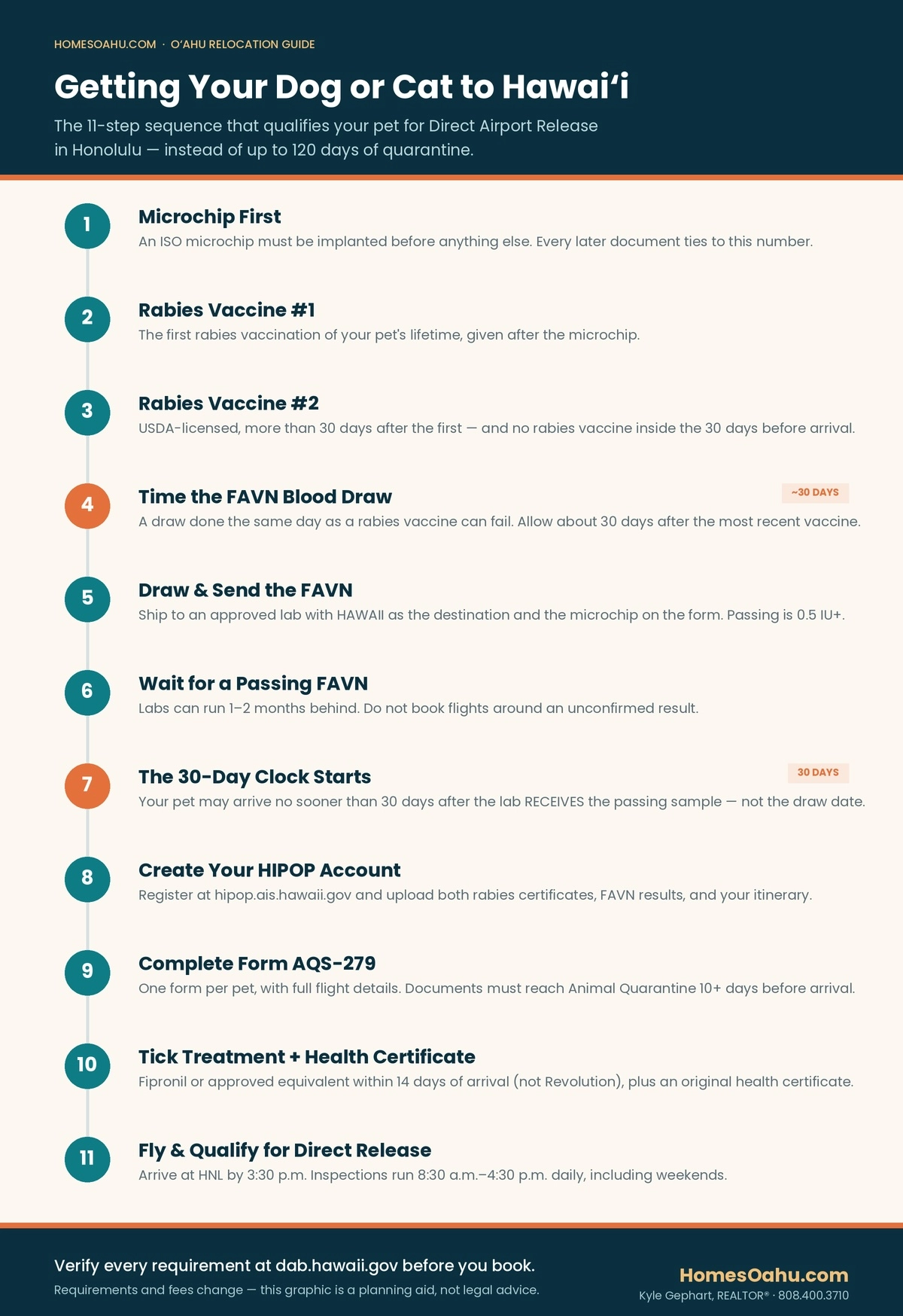
Microchip your pet
What Hawaiʻi requires: an electronic microchip implanted prior to or at the time the FAVN blood sample is collected, with the microchip number recorded on the laboratory submission form. Laboratories will not run the test without that number.
What we recommend: do it first, before any vaccination. Hawaiʻi does not require that sequence, but implanting the chip at the start means one identification number appears on every certificate and form in the file, which removes a common source of mismatch later.
At the airport this matters more than anything else in your paperwork: DAB states that if the microchip cannot be read on arrival, the animal does not qualify for Direct Airport Release or the 5 Day Or Less program. Ask your vet to scan and confirm the chip at every visit, including the last one before you fly.
First rabies vaccination
Hawaiʻi requires at least two rabies vaccinations in the animal’s lifetime. This is the first of them. Keep the signed certificate.
Second rabies vaccination, more than 30 days after the first
The two vaccinations have to be more than 30 days apart, using USDA-licensed vaccines. A pet with a single lifetime rabies vaccination does not qualify, however current it is.
If your pet already has a documented vaccination history, that history counts — what you need is a booster given more than 30 days after the prior documented vaccination, not a fresh two-shot series. Worth pulling your pet’s full record from every vet who has treated it before you assume the worst.
Two constraints attach to the most recent vaccination, in Checklist 1’s wording: it has to have been given more than 30 days before the arrival date, and not more than the vaccine’s licensed booster interval listed on the manufacturer’s label. DAB advises making sure a veterinarian does not inadvertently administer a rabies vaccination inside that 30-day window.
Time the FAVN blood draw so the titer passes Recommended
This is veterinary timing advice, not a Hawaiʻi waiting period. DAB’s Summary For Veterinarians (AQS-39) notes: “If blood is collected for the OIE-FAVN test at the same time as rabies vaccination, your animal may fail the test. If this occurs, repeat testing in 10 to 14 days usually results in an adequate test result.”
Allowing roughly a month after the most recent vaccination before the draw is a common way to reduce the chance of an inadequate titer. Nothing in Hawaiʻi’s rules requires you to wait before drawing — the waiting periods Hawaiʻi does impose are both measured to your arrival date, and they are the subject of Step 7. Confirm the timing with your veterinarian for your specific animal.
Draw the FAVN sample and send it to an approved laboratory
The OIE-FAVN (Fluorescent Antibody Virus Neutralization) test measures the rabies antibody level in your pet’s blood. A passing result is 0.5 International Units (IU) or more. Hawaiʻi accepts results from a short list of laboratories — Kansas State University, Auburn University, the University of Missouri, and the Department of Defense laboratory (DoD beneficiaries only).
Three details worth confirming with your vet before the sample ships: the submission form lists HAWAII as the destination; the microchip number is recorded on the form; and the test ordered is the OIE-FAVN. Kansas State’s “Micro Rabies Screen Test” (also sold as “Micro RFFIT” or “MRS”) is a different test with a similar name and DAB states it is not accepted.
On the 36-month figure: Checklist 1 frames it as a window rather than a shelf life. The day after the laboratory received the sample has to be not more than 36 months and not less than 30 days before the arrival date — the same measurement sets both ends. A result inside that window still only helps if the other requirements are satisfied too, including the rabies vaccination rules in Step 3.
One scheduling trap: Checklist 1 warns that routing the sample through an intermediate laboratory such as Antech or Idexx may delay the date the approved lab actually receives it — and receipt is what starts your clock. Ask your vet to ship direct.
Wait for a passing result
DAB has posted that FAVN laboratories are experiencing longer than usual processing times, with results delayed one to two months. In practice this, not the regulation, is what sets most timelines. Plan around it rather than around the minimum.
You do not need to chase the laboratory. If “Hawaii” was listed as the destination, results are transmitted to the state directly, and you can look up your pet’s result and the date its waiting period completes with DAB’s microchip search tool. DAB asks that owners not call laboratories for results.
Work out your earliest arrival date Sets your date
Two conditions have to be satisfied by the date your pet lands, and they are both measured to arrival — not to each other.
One: the 30-day FAVN waiting period is complete. Checklist 1 states the waiting period begins the day after the approved laboratory received the blood sample — not the draw date and not the reporting date. Two: the most recent rabies vaccination meets Hawaiʻi’s timing requirement — more than 30 days before arrival, and not expired on arrival.
These periods can run at the same time. They are two eligibility tests applied to one date, not two waits stacked end to end. Whichever condition is satisfied later is your earliest possible arrival date. Build your flight search around that date.
Arriving early is not a partial miss. Checklist 1 is explicit: arriving before the 30-day waiting period has elapsed “will result in disqualification of a pet from the 5 Day Or Less quarantine program and direct airport release. All pets arriving before the eligible date of entry will be quarantined and assessed $14.30 each day in addition to the $244.00 program fee. There are no exceptions.” Treat your eligibility date as hard.
Create your HIPOP account and submit your documents
The Hawaiʻi Pet Owner Portal (HIPOP) is DAB’s online application system. Each dog and cat needs its own animal file under your owner account. DAB states that supporting documents are uploaded when you create an application — rabies vaccination certificates, FAVN results, health certificates, and your itinerary — and that fees are payable by Visa or Mastercard in the portal.
If you have applied to Animal Quarantine before, an account may already exist. Enter the email address you used previously and select “Forgot Your Password” rather than creating a duplicate. Paper applications by mail are still accepted, and the mailed process has its own document instructions — check the checklist that matches your route before assuming the two are interchangeable.
The mailed route has stricter document rules than the portal. Checklist 1, which governs paper submission, calls for original certificates for the two rabies vaccinations signed in ink by a licensed veterinarian, and states plainly that faxes and photocopies are not accepted. If you file by mail, follow that. If you file through HIPOP, follow the portal’s upload instructions.
Either way, carry the originals with you rather than in checked luggage. Checklist 1 requires an original health certificate in English completed within 14 days of arrival, and states that where it was not sent ahead it has to be handed to the inspector — “Failure to bring the original health certificate (photocopy not acceptable), will prevent your pet from being released.” DAB also advises keeping copies to accompany the pet as backup.
Complete Form AQS-279 with your flight itinerary
One AQS-279 Dog & Cat Import Form per pet, submitted with your pre-arrival documents and including airline, flight number, and arrival date and time.
Timing: DAB requires documents to be received no less than 10 days before arrival to qualify for the published Direct Airport Release fee. Later than that — including documents produced on arrival — and the fee rises from $185 to $244 per animal, with DAB cautioning that it may not be possible to process those cases on arrival.
Tick treatment, health certificate, and the screwworm statement
Checklist 1 states a veterinarian treats the pet for ticks with a long-acting product labelled to kill ticks within 14 days of arrival, with the product name and treatment date recorded on the health certificate, and that Revolution is not acceptable. Check DAB’s list of acceptable tick treatments before the appointment.
The health certificate is completed in English within 14 days of arrival and includes the rabies vaccine name, lot or serial number, booster interval, vaccination date and expiration date. Note separately that Checklist 1 states a pet will not qualify for Direct Airport Release if ticks or other parasites are found at the time of arrival.
Screwworm: DAB currently requires that animals needing a certificate of veterinary inspection for import carry the certifying statement “All animals were inspected and found free of evidence of New World Screwworm infestation.” Ask your veterinarian to inspect for it and to include that language verbatim. Confirm on the DAB page that the requirement is still in force when you travel.
Fly to Hawaiʻi and qualify for Direct Airport Release
No permit is required to fly a dog or cat into Honolulu — the permit requirement applies to the neighbor islands. If the requirements have been met and your documents arrived on time, your pet is inspected at the Airport Animal Quarantine Holding Facility and released to you the same day. Arrival logistics are worth reading before you book; they are covered further down.
How Long Does It Take to Bring a Pet to Hawaiʻi?
Plan four to six months. The two eligibility conditions in Step 7 run to the same arrival date and can overlap, so they do not simply add together. What stretches the calendar is the sequence in front of them — the interval between rabies vaccinations, and laboratory turnaround that DAB has posted as running one to two months.
| What drives the calendar | Typical | Note |
|---|---|---|
| Microchip and first rabies vaccination | 1–2 weeks | Veterinary scheduling |
| Interval between the two rabies vaccinations | 5+ weeks | More than 30 days apart is a requirement |
| Gap before the FAVN draw | ~30 days | Veterinary recommendation, not a Hawaiʻi waiting period |
| FAVN laboratory turnaround | 1–2 months | DAB-posted delay; usually the binding constraint |
| Earliest arrival date | — | The later of: 30 days from lab receipt, or the rabies timing requirement |
| Document submission window | 3–4 weeks ahead | 10+ days is the requirement; earlier is safer |
If your pet already has two lifetime rabies vaccinations on record more than 30 days apart, you can skip the front of that sequence entirely. Worth checking before assuming the longer path.
Start as soon as orders look likely rather than when they are cut. The laboratory backlog is indifferent to your report date, and it is the part you cannot compress. If your pet’s eligibility date lands after you have to fly, boarding it on the mainland until it is eligible is usually cheaper than arriving early and paying the per-day charge plus quarantine. For the housing side of the same clock, see our guide to Oʻahu school districts and neighborhoods for military PCS moves.
How Much Does Direct Airport Release Cost?
State fees are separate from veterinary bills, laboratory fees, the crate, and airline charges. These are the figures DAB publishes on the Animal Quarantine Information Page; confirm them there before you send payment.
| Fee | Amount | Applies when |
|---|---|---|
| Direct Airport Release, Honolulu | $185 | Per dog or cat, documents received 10+ days before arrival |
| Direct Airport Release, late documents | $244 | Documents received under 10 days out, including on arrival |
| 5 Day Or Less program | $244 | Per animal |
| Neighbor Island Inspection Permit | $165 | Direct release at Kona, Kahului, or Līhuʻe |
| Arriving before eligible (Honolulu) | $14.30/day + $244 | Charged per day arrived early |
| Overnight hold not collected by 10 a.m. | +$59 | Late afternoon and evening arrivals |
| Re-entry fee, if qualified | $98 | $130 if documents are received under 10 days out |
Cashier’s checks and money orders are made payable to the Department of Agriculture & Biosecurity; DAB states personal checks are not accepted. The HIPOP portal takes Visa and Mastercard.
Where Pet Moves to Hawaiʻi Go Wrong
These are the failure points worth checking twice. Consequences vary by which one you hit and when you arrive — some add a fee, some add days, some change which release program your pet qualifies for.
- ✕An unreadable microchip on arrival. DAB states the animal will not qualify for Direct Airport Release or the 5 Day Or Less program. Have it scanned at every visit.
- ✕Collecting the FAVN sample at the same time as a rabies vaccination. DAB warns this can produce a failed test. You pay twice and lose weeks.
- ✕A rabies vaccination administered inside the 30 days before arrival. DAB flags this specifically — a well-meaning top-up before the move can push your pet outside the requirement.
- ✕A most-recent vaccination that expires before the arrival date. Validity is measured at arrival: 12 months for 1-year licensed vaccines, 36 months for 3-year.
- ✕Ordering the wrong test. The Micro Rabies Screen is not the OIE-FAVN, and DAB states it is not accepted. Confirm the test and that HAWAII is the listed destination before the sample ships.
- ✕Booking travel around an unconfirmed FAVN result. Laboratory delays are posted at one to two months; the eligibility clock does not start until a passing sample is received.
- ✕A tick treatment outside the requirement. The certificate confirms fipronil or an equivalent within 14 days of arrival, and DAB states Revolution is not acceptable.
- ✕Documents received later than 10 days before arrival. That moves the release fee from $185 to $244, and DAB cautions late cases may not be processable on arrival.
- ✕Arriving before your eligibility date. DAB publishes a per-day charge plus quarantine until the outstanding period completes.
- ✕Landing too late in the day. Inspections stop in the afternoon and it takes time to move a pet from the aircraft to the facility. Details below.
- ✕Arranging a vehicle that will not fit the crate. Your pet is released in its crate and airport rules do not allow taking it out on airport property.
Which Airlines Will Carry Your Pet to Hawaiʻi?
“Does this airline take pets” is the wrong question. What determines whether your animal can fly is the transportation method — in the cabin, as accompanied checked baggage, or as cargo — and each method carries its own breed, aircraft, temperature, route, and capacity restrictions. A carrier can accept your pet one way and decline it another, on the same flight.
Clearing DAB gets your pet released once it lands. It does not get your pet on the aircraft. Those are separate approvals from separate authorities, and the airline’s is the one people discover late.
The four transportation methods
- In cabin — a small animal in a carrier under the seat in front of you. Weight and carrier dimensions are capped, and the number of animals per flight is usually limited, so space can run out.
- Accompanied checked baggage — your pet travels below deck on your flight in a hard-sided kennel. This is where breed, aircraft, temperature, and seasonal restrictions concentrate.
- Cargo — your pet ships as freight, booked through the carrier’s cargo division rather than the passenger reservation system, and does not have to travel on your flight.
- A pet shipper or intermediate handler — a third party arranges routing and handling, sometimes on services not available to you directly. Covered below.
What each carrier currently publishes
Verified against each carrier’s own policy pages in August 2026. These are snapshots of volatile policies, not permanent rules, and a carrier’s cargo division may apply a different standard from its passenger pages.
| Carrier | What its current policy states | Source |
|---|---|---|
| Alaska / Hawaiian operating a combined programme after the 2024 merger |
Small pets in the cabin, larger pets in the baggage compartment. Alaska states cabin pets are accepted on all flights, while it limits how many dogs and cats it accepts as checked baggage on flights to or from Hawaiʻi because of seasonal headwinds — a limit it says does not apply to cabin travel. Baggage-compartment travel is separately subject to breed restrictions, travel-date embargoes and fleet restrictions, including a cargo-hold embargo on French and English Bulldogs from July 31 to September 30 that does not affect cabin travel. Alaska also notes only dogs and cats may be brought into Hawaiʻi and that the state’s programmes must be completed first. | Hawaii pet travel · pets in baggage |
| Delta | Delta’s in-cabin pet exceptions list Hawaiʻi among destinations where pets are not permitted in the cabin, stating pet travel is not allowed on flights to Hawaiʻi. Delta maintains separate pages for shipping pets as cargo and for military and State Department pet travel; check those directly if either applies to you. | delta.com |
| American Airlines Cargo | Transports warm-blooded animals when ground temperatures are between 45°F and 85°F, and will not transport them above 85°F or below 20°F. Temperatures are assessed against departure and arrival times for every station on the itinerary. Between 20°F and 44°F a veterinarian’s letter of acclimation is required. | aacargo.com |
| United | United states it no longer accepts PetSafe reservations, its cargo pet programme. A separate provision allows U.S. military on current PCS orders and State Department Foreign Service personnel on reassignment to transport dogs and cats as checked baggage between Guam and Honolulu only, under stated conditions. | united.com |
This table covers only what we could confirm on the carriers’ own pages. A carrier’s absence here means we did not verify it, not that it accepts or refuses pets. Secondhand summaries of airline pet policy — including ours — go stale quickly, and the cargo desk sometimes applies a stricter standard than the published page.
Confirm these before you buy a ticket
Call the airline and get agreement on all of it together, because these interact. A breed that is fine in November may be embargoed in August; an aircraft swap can change the answer after you book.
- The specific animal — species, breed or mix, weight, and age
- The transportation method you are asking for: cabin, checked baggage, or cargo
- The crate — type, dimensions, and whether it meets that carrier’s kennel standard
- Origin, connections, and destination, including the neighbor-island leg if there is one
- The aircraft type on each segment, since fleet restrictions apply on some carriers
- The travel date, against seasonal embargoes and forecast temperatures at every station
- Capacity — whether a cabin or hold slot is actually available on that flight
- Whether any military, government, or other exception applies to you
Get the answer tied to your booking rather than as general guidance, and re-confirm if your itinerary changes.
Flat-faced breeds need an early answer
Brachycephalic animals — Bulldogs, Frenchies, Pugs, Boxers, Boston Terriers, Persian and Himalayan cats — breathe less efficiently, and restrictions on carrying them below deck are common across the industry. Alaska publishes a seasonal cargo-hold embargo on French and English Bulldogs, and notes separately that baggage-compartment travel is subject to breed restrictions generally. Other carriers set their own, and they are not identical.
The practical consequence: if your dog is flat-faced and too heavy for the cabin, you may have a narrow set of options, and finding that out in month five is expensive. Ask the carrier in month one, at the same time you book the microchip.
Pet shippers and registered intermediate handlers
Hawaiʻi formally recognises a category for this. DAB maintains a list of registered intermediate handlers — private individuals and organisations that may be contracted with for a fee to assist with interstate and inter-island pet shipping — published in the FORMS section of the Animal Quarantine Information Page. That listing is a registration, not an endorsement or a quality rating.
One Oʻahu-based operator is Island Pet Movers, near the airport. The following are the company’s own descriptions of its services, taken from its site, and service offerings can change:
- It states it moves bully breeds year-round, including English and French Bulldogs, Pugs, Boston Terriers and snub-nosed mixes.
- It describes routing pets by ground transport to a West Coast airport, and a partnered cargo-only airline offering a climate-controlled LAX–HNL service in which animals travel in the aircraft cabin.
- It offers mainland boarding, inter-island transfers, quarantine visitation, and military and DoD PCS relocations.
- It states that some carriers decline bully breeds regardless of season, and that many airlines refuse certain flat-faced breeds between mid-May and mid-September — a claim about other companies’ policies that you should confirm with the carrier directly.
Mainland boarding is the option most worth knowing about, because it solves a real scheduling problem: if your report date arrives before your pet’s eligibility date, boarding on the mainland and flying the pet later is usually cheaper than arriving early and paying the per-day charge plus quarantine.
If you are comparing shippers, ask each to walk you through the exact routing — carrier, aircraft, connections, and what happens if a leg cancels — and check membership in IPATA, the International Pet and Animal Transportation Association. Get more than one quote. We have no affiliation with any pet transport company and receive nothing for naming one.
What Happens on Arrival Day at Honolulu?
DAB states inspection hours for dogs and cats at Daniel K. Inouye International Airport run 8:30 a.m. to 4:30 p.m. daily, including weekends and holidays, and advises arranging flights to arrive by 3:30 p.m. The reason for the earlier target is that it can take up to an hour for the airline to move your pet to the Airport Animal Quarantine Holding Facility, and animals that do not reach the facility by 4:30 p.m. are not released that day.
Pets arriving outside those hours are held and inspected the following morning. Checklist 1 states that pets qualified for Direct Airport Release arriving between 5:00 p.m. and 8:00 a.m. are collected between 8:00 and 10:00 a.m. during the next inspection period, and that if they are not, the pet is transferred to the Animal Quarantine Station and entered into the 5 Day Or Less programme at $244. DAB’s information page separately lists a $59 charge for a held pet not collected by 10:00 a.m. Either way the lesson is the same: collect first thing. If you are connecting onward, note DAB’s caution that limited weekend inter-island service means pets arriving Thursday or Friday may not transfer to satellite stations or approved neighbor island hospitals until the following Monday.
You lift the crate yourself
After release documents are signed, DAB states crated animals are released to the owner or handler at the facility, and that staff deliver and off-load crates only to the sidewalk in front of the building. Owners are responsible for lifting crates into vehicles or onto luggage carts.
Airport security rules do not permit animals to be taken out of the transport crate on airport property, so the crate goes into your vehicle intact, with the pet inside. DAB also notes there are no baggage carts or porters in the immediate vicinity of the facility. Two practical consequences worth planning for: the vehicle has to physically fit the assembled crate, and if you are travelling with a large dog in a 400- or 500-series kennel, arrange a second set of hands.
Four details from Checklist 1 that catch people out
- Your pet can only be released to specific people. Checklist 1 lists the owner named on the AQS-279, the consignee on the shipmaster’s declaration, or a co-owner or authorised handler named on the AQS-279. If you are not travelling with your pet, arrange with the airline to consign it to whoever is collecting. DAB also states handlers and transport companies cannot be listed as owners, and that misidentifying the legal owner is considered fraud.
- Ticks or other parasites found at arrival disqualify Direct Airport Release, whatever treatment is recorded on your certificate.
- An animal not collected on its scheduled release date is treated as overdue, and Checklist 1 states an additional $17.80 is added for each day beyond that date.
- Bring a baggage cart if you are connecting to a neighbor island. DAB notes there are no carts or porters at the facility. Animals on international flights also clear U.S. Customs before release, and Direct Airport Release is not possible when federal airport security advisories prohibit it.
Checklist 1 warns that inspection hours are subject to change without notice and gives the holding facility’s direct line as (808) 837-8092 — worth calling to confirm before you book, and to notify them if you cannot collect your pet the day it arrives. Verify current hours and procedures on the Animal Quarantine Information Page and in Checklist 1 before you travel.
Can You Fly a Pet Straight to Kona, Kahului, or Līhuʻe?
Yes, with a Neighbor Island Inspection Permit (NIIP), and the process is stricter than Honolulu’s rather than looser. No permit is needed to fly into Honolulu; the permit applies only to Kona (KOA), Kahului (OGG), and Līhuʻe (LIH).
- The NIIP is issued by DAB and presented to the airline before boarding.
- DAB requires documentation to be received 30 days or more ahead of the planned arrival — three times the Honolulu window.
- You contract in advance with an approved veterinary facility on that island, which confirms to DAB that it will perform the inspection. DAB states permits will not be issued without that confirmation.
- A confirmed passing FAVN result is needed first. DAB states permits are not issued on a pending test, and advises doing the FAVN well in advance for this reason.
- Not every airline participates in neighbor-island pet transport. Confirm before booking.
- DAB states pets denied entry at a neighbor island airport are transported to Honolulu for inspection or shipped out of state at the owner’s expense.
The relevant checklists are Checklist 2 for pets outside Hawaiʻi and Checklist 4 for pets already living here and returning.
Which Places Are Exempt From Hawaiʻi’s Quarantine Programme?
DAB publishes a separate, shorter checklist for animals arriving from areas it recognises as rabies-free: the British Isles, Australia, Guam, and New Zealand. Pets from Guam also require an Affidavit for Export from Guam to Hawaiʻi (Form IC-5). Arrivals from the U.S. mainland follow the full process above.
Will Your Oʻahu Home Actually Allow Your Pet?
Clearing DAB does not establish that a particular condominium, townhouse, rental, HOA, or AOAO will permit your specific animal. Those are separate authorities with separate documents, and property-level pet restrictions are set in the governing documents rather than by the state.
Oʻahu condominium and AOAO rules may include pet-number limits, weight limits, registration requirements, restrictions on particular animals, common-area rules such as which lifts or paths pets may use, or other property-specific conditions. Which of those apply, and at what thresholds, varies by property — there is no island-wide standard to rely on, which is exactly why it has to be checked per address.
It does not tell you the number of animals allowed, any weight limit, which species or types are permitted, whether registration with the resident manager is required, what the common-area rules are, or whether existing pets were grandfathered under rules that have since changed. Treat it as a prompt to verify, not as an answer.
A verification sequence that works
- Start with the listing language — note what it claims, and treat it as unverified.
- Ask the seller or listing agent for the specific pet provisions in writing.
- Read the governing documents — declaration, bylaws, and house rules, including amendments. These control.
- Confirm with the current AOAO or association, because house rules are amended and the recorded set may not be the operative one.
- Compare the actual restrictions against your actual animal — its species, weight, breed, and how many you have.
Run that sequence before you are emotionally committed to a unit, not during escrow. If you have a large dog or more than one animal, single-family homes and townhomes generally involve fewer shared-property rules than high-rise condominiums. This is the same category of check as parking stalls and lanai rules — see what to verify before buying an Oʻahu condo, and our Oʻahu relocation guide for the rest of the move.
Frequently Asked Questions
Can I bring my dog to Hawaiʻi without quarantine?
If your dog meets the requirements of the 5 Day Or Less programme, it can qualify for Direct Airport Release and be released to you at Daniel K. Inouye International Airport the same day, after inspection. Animals that do not meet the requirements are subject to quarantine, which can run up to 120 days in applicable circumstances. Which outcome applies depends on what is incomplete and when the animal arrives.
How long does it take to bring a pet to Hawaiʻi?
Plan four to six months. The two eligibility conditions both run to your arrival date and can overlap, so they do not add together — what stretches the calendar is the interval between rabies vaccinations plus laboratory turnaround, which DAB has posted as running one to two months. If your pet already has two lifetime rabies vaccinations more than 30 days apart, the front of that sequence drops away.
Does Hawaiʻi require two separate 30-day waiting periods?
Not sequentially. There are two eligibility conditions, and both are measured to the arrival date: completion of the 30-day FAVN waiting period, which Checklist 1 states begins the day after the approved laboratory received the blood sample, and a most recent rabies vaccination given more than 30 days before arrival and within the vaccine’s licensed booster interval. Because both are tested against the same date, they can run concurrently. Whichever is satisfied later determines the earliest your pet can arrive.
Does my pet have to be microchipped before its first rabies vaccination?
No. DAB’s requirement is that the microchip be implanted prior to or at the time the FAVN blood sample is collected, with the number recorded on the laboratory submission form. Microchipping first, before any vaccination, is our practical recommendation rather than a rule — it keeps one identification number on every document. Separately, DAB states that if the chip cannot be read on arrival the animal does not qualify for Direct Airport Release or the 5 Day Or Less programme.
How many rabies vaccinations does my pet need?
At least two in its lifetime, given more than 30 days apart, using USDA-licensed vaccines. If your pet has a documented vaccination history, a booster given more than 30 days after the prior documented dose satisfies the second. Two timing constraints attach to the most recent vaccination: it cannot be expired on the arrival date (12 months for 1-year licensed vaccines, 36 months for 3-year), and DAB states no rabies vaccination may be given within the immediate 30 days before arrival.
What is the FAVN test and which laboratories does Hawaiʻi accept?
The OIE-FAVN measures the rabies antibody level in your pet’s blood; a passing result is 0.5 IU or more. DAB lists Kansas State University, Auburn University, the University of Missouri, and the Department of Defense laboratory (DoD beneficiaries only). HAWAII must be listed as the destination on the submission form and the microchip number recorded on it. Kansas State’s Micro Rabies Screen Test, also called Micro RFFIT or MRS, is a different test and DAB states it is not accepted.
Is a passing FAVN result good for 36 months?
Checklist 1 frames it as a window rather than a shelf life: the day after the laboratory received the sample has to be not more than 36 months and not less than 30 days before the arrival date. A result inside that window still only helps if the other requirements are satisfied, including the rabies vaccination rules. Confirm with DAB before relying on an older result.
When does the FAVN waiting period start?
Checklist 1 states the waiting period begins the day after the approved laboratory received the blood sample — not the draw date and not the reporting date. Checklist 1 also warns that routing the sample through an intermediate laboratory such as Antech or Idexx can delay the date the approved lab receives it, which pushes your eligibility date back. You can check the result and completion date through DAB’s microchip search tool.
Do I have to mail original documents, or can I upload them?
Both routes exist and their document rules differ. Through DAB’s HIPOP portal you create an animal file for each pet and upload supporting documents — two rabies vaccination certificates, FAVN results, health certificate and itinerary — and pay by card. DAB confirms mailed applications are still accepted, and Checklist 1, which governs the paper route, calls for original rabies certificates signed in ink and states faxes and photocopies are not accepted. Either way, carry the originals with you: Checklist 1 requires an original health certificate and states that failure to bring it, with a photocopy not acceptable, will prevent your pet from being released.
How much does Direct Airport Release cost in Honolulu?
DAB publishes $185 per dog or cat when documents are received 10 or more days before arrival, and $244 when they arrive later than that, including documents produced on arrival. Other fees apply to neighbor-island permits, early arrival, and overnight holds. Confirm current figures with DAB before paying.
What time does my flight need to land in Honolulu?
DAB advises arranging to arrive by 3:30 p.m. Inspection hours are 8:30 a.m. to 4:30 p.m. daily including weekends and holidays, and it can take up to an hour for the airline to move a pet to the holding facility. Animals not reaching the facility by 4:30 p.m. are not released that day; a pet held overnight and not collected by 10:00 a.m. incurs an additional $59.
Which airlines will fly my pet to Hawaiʻi?
It depends on the transportation method rather than the carrier alone. Alaska and Hawaiian, running a combined programme after their 2024 merger, accept cabin pets on all flights and limit how many dogs and cats they take as checked baggage on Hawaiʻi routes because of seasonal headwinds; baggage-compartment travel is separately subject to breed, embargo and fleet restrictions. Delta lists Hawaiʻi among its in-cabin pet exceptions, stating pet travel is not allowed on flights to Hawaiʻi. American Airlines Cargo publishes temperature limits of 45°F to 85°F assessed at every station on the itinerary. United states it no longer accepts PetSafe reservations, with a military and State Department provision covering Guam to Honolulu only. Confirm your specific animal, breed, crate, route, aircraft, date and method with the airline before buying travel.
Can a French Bulldog or Pug fly to Hawaiʻi?
Ask the carrier early, because the answer turns on method and season. Alaska publishes a cargo-hold embargo on French and English Bulldogs from July 31 to September 30 that does not affect cabin travel, and notes baggage-compartment travel is subject to breed restrictions generally. Restrictions on flat-faced breeds below deck are common across the industry and differ by carrier. If your dog is both flat-faced and too heavy for the cabin, your options narrow and a pet shipper may be the route — worth establishing in month one.
What if my pet is not eligible until after I have to move?
Boarding your pet on the mainland until its eligibility date, then flying it over, is generally cheaper than arriving early. Checklist 1 states that arriving before the waiting period has elapsed disqualifies the pet from both Direct Airport Release and the 5 Day Or Less programme, and that early arrivals are quarantined and assessed $14.30 each day in addition to the $244 programme fee, with no exceptions. Several pet shippers offer mainland boarding for this situation, which comes up often on PCS timelines.
Who is allowed to collect my pet at the airport?
Checklist 1 states an animal may be released only to the owner named on the Dog & Cat Import Form (AQS-279), the consignee identified on the shipmaster’s declaration, or a co-owner or authorised handler named on the AQS-279. If you are not travelling with your pet, arrange with the airline to consign it to the person collecting. DAB also states handlers and transport companies cannot be listed as owners, and that failing to identify the legal owner on the form is considered fraud and will cause delays and disqualification.
Do guide dogs and service dogs follow this process?
Hawaiʻi maintains a separate procedure for qualifying guide and service dogs entering without quarantine, so work from DAB’s guide and service dog requirements rather than this checklist. Emotional support animals are not treated as service animals under that procedure and follow the standard dog and cat process. Since January 1, 2019, misrepresenting an animal as a service animal is a violation of state law and civil penalties may be assessed.
Are puppies and kittens treated differently?
The requirements are the same, which works against them on timing. Because of the interval between vaccinations and the waiting period before arrival, DAB notes a newborn will be roughly six months old by the time preparations are complete. Puppies and kittens that do not meet the 5 Day Or Less requirements are subject to quarantine.
Are any breeds not allowed into Hawaiʻi?
Non-domestic dogs and cats and their hybrids are prohibited under Plant Quarantine law — including wolf and wolf crosses, Dingo, Bengal, and Savannah. That sits with the Plant Quarantine Branch rather than Animal Quarantine, so check its animal import guidelines directly.
My pet already lives in Hawaiʻi. Do we repeat this to travel?
Not the full process, but there is a specific one. DAB publishes Checklist 3 for pets living in Hawaiʻi that depart and return through Honolulu, and Checklist 4 for neighbor-island return, and notes the waiting period after a successful rabies blood test is modified and completed before leaving the state. A reduced re-entry fee may apply if the pet qualifies.
Will my Oʻahu condo allow my dog?
That is a separate question from the state’s, decided by the property’s governing documents. Oʻahu condominium and AOAO rules may include pet-number limits, weight limits, registration requirements, restrictions on particular animals, or common-area rules, and they vary by property. “Pet friendly” in listing copy does not establish any of those. Read the declaration, bylaws and house rules, confirm the current position with the AOAO, and compare the actual restrictions against your actual animal before going under contract.
Pre-Flight Verification Checklist
Work through this in the fortnight before you fly.
- ✓Have your vet scan the microchip and confirm the number matches every certificate and lab form.
- ✓Confirm the FAVN was the OIE-FAVN, not a Micro Rabies Screen, sent to an approved laboratory with HAWAII as the destination.
- ✓Look up the result and the waiting-period completion date on DAB’s microchip search tool and screenshot it.
- ✓Confirm your arrival date satisfies both eligibility conditions — the FAVN waiting period, counted from the day after the lab received the sample, and the rabies vaccination timing requirement.
- ✓Confirm no rabies vaccination was given inside the 30 days before arrival, and that the most recent one is not expired as of the arrival date.
- ✓Confirm AQS-279 and supporting documents were received 10+ days out (30+ days for neighbor islands), not merely sent.
- ✓Confirm the tick treatment was a long-acting product labelled to kill ticks, given within 14 days of arrival (not Revolution), with product and date recorded on the health certificate.
- ✓Confirm the health certificate is from a USDA-accredited veterinarian and includes the New World Screwworm certifying statement if still required.
- ✓Carry the original health certificate and original rabies certificates with you rather than in checked luggage — a photocopy will not do.
- ✓Re-confirm with your airline that your animal, breed, crate, route, aircraft, date and transportation method are all still accepted.
- ✓Confirm your flight lands by 3:30 p.m. HST.
- ✓Confirm the vehicle meeting you at HNL fits the intact crate with the pet inside.
- ✓Confirm who is authorised to collect your pet — the owner or an authorised handler named on the AQS-279.
- ✓If buying or renting, get the AOAO or landlord pet rules in writing before you sign.
Primary Sources
- Animal Quarantine Information Page — DAB’s authoritative page for requirements, fees, checklists and advisories
- HIPOP — Hawaiʻi Pet Owner Portal for online applications and document upload
- Form AQS-279 — Dog & Cat Import Form
- Checklist 1 (Honolulu arrival) · Checklist 2 (neighbor island arrival)
- Summary For Veterinarians (AQS-39) — the document to hand your vet
- FAVN results by microchip number
- Acceptable tick treatments
- Guide and service dog requirements
- Animal Quarantine Station — (808) 483-7151 · 99-951 Hālawa Valley Street, ʻAiea, HI 96701. DAB asks that questions go by email because of call volume and the time difference.
Moving to Oʻahu with a pet?
Start the DAB sequence early, ask your airline early, and get the property’s pet rules in writing before you commit. I front-load the checks that derail moves here — AOAO governing documents, parking, and what to verify by address.
Text “START” to 808.400.3710Contact KyleRequirements change — verify before you travel. Requirements on this page were reviewed against current Hawaiʻi Department of Agriculture & Biosecurity guidance in August 2026, and airline statements against each carrier’s own policy pages in the same month. Animal-entry requirements, forms, fees, submission procedures, airport procedures, temporary animal-health requirements, and airline transportation policies can all change without notice. This article is an editorial synthesis written for people relocating to Oʻahu; it is not veterinary, legal, or regulatory advice, and it does not replace DAB, your airline’s current policy, your veterinarian, or a property’s governing documents. Confirm current state requirements and your airline’s pet policy before booking travel, and verify property-specific pet rules for each address. Homes Oahu Holdings LLC is an Equal Housing Opportunity brokerage.